
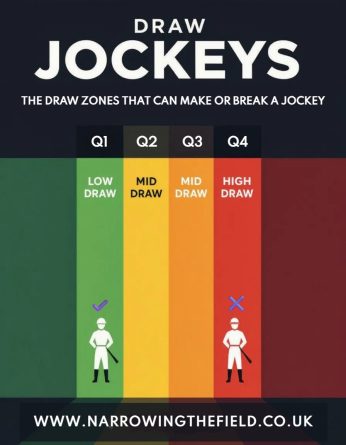
Draw Jockeys: Doncaster
One of the biggest misconceptions in racing is that a draw either helps… or it doesn’t…
The reality is far more interesting…
The same draw can be an advantage for one jockey and a disadvantage for another. Why? Because jockeys don’t ride races the same way. Some want a few different options. Some need cover. Some attack early. Some thrive when they can sit and wait…
That’s the idea behind my Draw Jockeys research>>>
Rather than looking at draw bias solely in isolation, I look at how specific jockeys perform from specific draw quarters, at specific tracks, under specific conditions. The results often reveal behavioural patterns that the market either completely ignores or consistently underestimates…
Below are two examples from Doncaster. One highlights a setup where Ryan Moore repeatedly excels. The other shows a scenario where Danny Tudhope’s performance drops well below market expectation.
Both are long-term patterns. Both are repeatable. And both demonstrate why understanding the jockey can be just as important as understanding the draw…
Let’s dive in… 👇
⭐ DONCASTER – RYAN MOORE
🔀 THE Q1-Q3 ADVANTAGE ZONES
(Positive Angle — Since 2007)
Doncaster is a track that rewards patience, balance, and tactical discipline.
Its long, galloping straight gives jockeys plenty of time to organise their challenge, but it also punishes those who waste energy early or commit before the race is ready to unfold.
It’s a track where positioning matters.
Where timing matters.
Where experienced riders consistently separate themselves from the pack.
And it’s a track where Ryan Moore excels when launching from the inner and middle draw quarters – Q1, Q2 and Q3 – over 1m2f and further.
Moore is a jockey built for these races. Given a horse with proven ability, a reasonable draw position, and enough time since its last run to arrive fresh, he repeatedly outperforms market expectations.
This isn’t a short-term trend.
This is a long-term behavioural pattern that has remained remarkably consistent for nearly two decades.
THE ANGLE
Ryan Moore | Doncaster | 1m2f+ | DSLR 16+ | SP <9/1 | Drawn Q1, Q2 or Q3
THE RESULTS (Since 2007)
- 30 wins from 78 rides
- 38% WIN strike-rate
- +£37.97 to SP
- 44 Win & Place from 78 (56%)
- +£41.38 Each-Way
- 47% ABOVE market expectation
These are elite numbers.
Few jockeys maintain this level of consistency over such a long period at one of Britain’s most demanding tracks.
WHY THIS ANGLE EXISTS
1. Moore thrives when given time to ride a race
Doncaster’s long straight allows him to stay patient, conserve energy, and produce his challenge exactly when he wants.
2. Q1-Q3 gives him tactical flexibility
From these draw zones, he can secure position without being forced into unnecessary early exertions.
3. He excels on proven horses
This angle focuses on runners priced below 9/1 with a recent run behind them. These horses arrive race-fit and capable of executing Moore’s tactical plan.
4. Doncaster rewards judgement
One of Moore’s greatest strengths has always been his decision-making under pressure. Doncaster’s layout allows that strength to shine.
The result is a long-term pattern of outperformance that the market continues to underestimate.
WHY THIS ANGLE MATTERS
Most punters know Ryan Moore is one of the best jockeys in the world.
What they often miss is where his style is most effective.
At Doncaster, over staying trips, from the inner and middle draw zones, with race-fit runners towards the front of the market, his record becomes exceptional.
This angle helps you:
- identify some of Moore’s strongest Doncaster setups
- understand when his tactical strengths matter most
- helps narrow fields more effectively
- avoid over-complicating races where the statistics are already pointing in one direction
- spot situations where the market still undervalues his advantage
This is the kind of positive behavioural pattern you can use to build confidence, structure, and clarity before the race is even run…
Now for a jockey who sits on the negative side at Doncaster, under certain draw conditions…
❌ DONCASTER — DANNY TUDHOPE
🔀 THE Q1 CONSTRAINT ZONE
(Negative Angle — Since 2004)
Doncaster’s races over 1 mile and further around a bend often look straightforward enough on paper…
In reality, they’re heavily influenced by positioning, race shape, and a jockey’s ability to secure clean passage before the race begins to develop.
It’s a track where patience matters.
Where flexibility matters.
Where getting trapped can be costly.
And it’s a track where Danny Tudhope’s record drops significantly when launching from the inside draw quarter (Q1).
Tudhope is a jockey whose strengths normally revolve around rhythm, balance, and producing his mount at the right moment. But from Q1 at Doncaster, over trips where the field quickly begins fighting for position into the bend, those strengths are repeatedly neutralised.
The result is a long-term negative pattern that has remained remarkably consistent…
THE ANGLE
Danny Tudhope | Doncaster | 1m+ (Round a Bend) | SP >2/1 | Drawn Q1
THE RESULTS (Since 2004)
- 2 wins from 39 rides
- 5% WIN strike-rate
- -£24.67 to SP
- 10 Win & Place from 39 (26%)
- -£34.15 Each-Way
- 59% below market expectation
His overall strike-rate at Donny (all draw quarters) sits at a shade above 13% (2% above market expectation) when he’s parked in Q1, however, those figures nosedive…
This remains a setup where Tudhope significantly underperforms what the market expects.
WHY THIS ANGLE EXISTS
1. The inside draw limits his options
From Q1, Tudhope is often forced into holding positions he wouldn’t ideally choose, especially as the field begins to organise itself around the bend.
2. His smooth rhythm is disrupted
Tudhope excels when he can gradually build momentum. The inside quarter regularly denies him that freedom.
3. Passage becomes the issue
Many of these races are won and lost before the straight, and Q1 frequently creates traffic and positioning challenges that compromise his mounts.
4. The market still respects him
When riding horses priced above 2/1, expectations remain relatively high. The results simply haven’t matched those expectations.
The outcome is a long-term pattern of underperformance that continues to fly below the radar.
WHY THIS ANGLE MATTERS
Most punters see Tudhope’s name and assume reliability.
But at Doncaster, over a mile and further around a bend, when drawn in Q1, the numbers tell a different story.
This angle helps you:
- identify vulnerable Tudhope setups
- remove false positives from your shortlist
- understand where draw position begins to work against his riding style
- spot horses the market may be overestimating
- helps narrow fields with greater confidence
This is the type of negative behavioural pattern you can use not to find winners… but to avoid losers…
The Bigger Picture
The Ryan Moore and Danny Tudhope angles highlight something I’ve found time and time again when researching Draw Jockeys…
The draw doesn’t affect every jockey equally
A low draw isn’t automatically good. A middle draw isn’t automatically bad. What matters is how a jockey’s riding style interacts with the position they’ve been handed, the shape of the track, and the tactical decisions they’re forced to make.
That’s where the real edge lies.
Most punters stop at the draw. A few go one step further and look at pace. Very few take the final step and analyse how individual jockeys repeatedly behave from specific draw zones.
That’s exactly what my free Draw Jockeys Guide is designed to uncover.
Inside, you’ll find a collection of positive and negative draw-quarter angles from some of the biggest tracks in Britain, showing you where the top jockeys consistently outperform market expectation… and also where they don’t!
If you’d like to see racing through a completely different lens, you can grab your free copy on the following link (or pop your details in the form at the bottom of this page)…
👉 Draw Jockeys: The Draw Zones That Make Or Break The Top Jockeys
Once you start looking at jockeys this way, you’ll never view the draw in quite the same way again…
Cheers – Ben (NTF)
interesting analysis thank you for sharing
Thanks Richard, glad you enjoyed it 👍
Ben (NTF)