
Draw Jockeys: Ayr
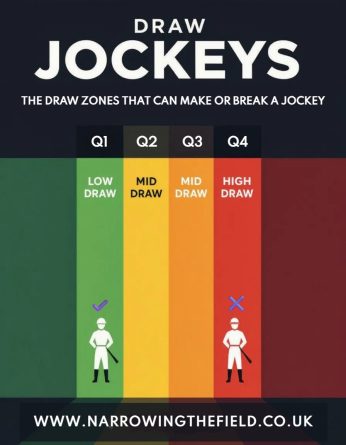
The Draw Doesn’t Impact Every Jockey Equally…
The Ayr Gold Cup meeting is one of those mini-festivals where small edges can make a huge difference…
Big fields. Competitive handicaps. Draw biases. Pace biases. And, increasingly, jockey behaviour patterns that the market still struggles to price correctly.
Most punters look at the horse…
Some look at the draw…
Very few look at how specific jockeys repeatedly perform from specific draw quarters.
That’s exactly what my Draw Jockeys research is all about.
Below are two Ayr angles that sit at opposite ends of the spectrum.
One highlights a situation where Andrew Mullen repeatedly outperforms expectations. The other shows a setup where James Sullivan’s record falls well below what the market predicts.
As ever, these aren’t opinions…
They’re long-term behavioural patterns that have held up over many years and a large number of races…
Let’s dive in…
⭐ AYR – ANDREW MULLEN
🔀 THE Q1/Q2 SWEET SPOTS
(Positive Angle – Since 2012)
Ayr is a track that rewards simplicity.
Its wide, galloping layout allows jockeys to settle into rhythm, secure position without excessive pressure, and gradually build momentum through the race.
It’s a track where balance matters…
Where efficiency matters…
Where covering unnecessary ground can quickly turn a winning chance into a losing one…
And it’s a track where Andrew Mullen excels when launching from the inside and middle-inside draw quarters – Q1 and Q2 – over trips of 7.5f to 1m5.5f.
Mullen is often at his best when he can establish position early, conserve energy, and let the race come to him. From these draw zones at Ayr, he repeatedly finds himself in exactly that situation.
The result is a long-term positive pattern that has remained remarkably strong for more than a decade.
THE ANGLE
Andrew Mullen | Ayr | 7.5f–1m5.5f | DSLR 30 or less | SP 9/1 or less | Drawn Q1 or Q2
THE RESULTS (Since 2012)
- 21 wins from 63 rides
- 33% WIN strike-rate
- +£73.17 to BFSP
- 27 Win & Place from 63 (43%)
- +£50.08 Each-Way
- 76% ABOVE market expectation
These are outstanding numbers.
Not only is Mullen winning regularly, he’s outperforming what the market expects by a significant margin.
WHY THIS ANGLE EXISTS
1. The draw gives him tactical freedom
From Q1 and Q2, Mullen can secure an economical position without having to waste energy fighting for it.
2. Ayr rewards efficient riders
The track’s layout allows him to settle his mounts and gradually build momentum rather than forcing the issue early.
3. Race-fit horses suit the profile
This angle focuses on horses returning within 30 days, meaning they’re arriving match-fit and ready to perform.
4. The market still underestimates the setup
Despite the consistency of the results, runners fitting this profile continue to outperform market expectation.
The result is a long-term pattern of profitable over-performance that has stood the test of time.
WHY THIS ANGLE MATTERS
Most punters see Andrew Mullen as a reliable northern jockey, which he is…
What they often miss, however, is where his strengths become amplified.
At Ayr, over middle-distance and staying trips, when drawn in Q1 or Q2, riding race-fit runners near the front of the market, his record becomes exceptional.
This angle helps you:
- identify Mullen’s strongest Ayr setups
- understand when draw position is working in his favour
- narrow fields more effectively
- spot runners capable of outperforming expectations
- build confidence around a proven long-term pattern
This is the kind of positive behavioural angle that can be used to uncover value hidden in plain sight…

Doors now open>>>
❌ AYR – JAMES SULLIVAN
🔀 THE Q3/Q4 DANGER ZONES
(Negative Angle – Since 2012)
Ayr is often viewed as one of the fairest tracks in the country.
Its wide expanses and long straights give every horse a chance to find a rhythm and organise a challenge. But when fields get bigger, position becomes increasingly important and riders drawn away from the favoured lanes can find themselves making compromises before the race has truly begun.
It’s a track where efficiency matters…
Where track position matters…
Where covering extra ground can be costly…
And it’s a track where James Sullivan’s performance drops dramatically when launching from the outer draw quarters – Q3 and Q4 – over 7f to 1m5f in fields of eight or more runners.
Sullivan is a jockey who generally performs best when able to establish a comfortable position early and build into the race. From the outer quarters in competitive fields, that task becomes considerably more difficult.
The result is a long-term negative pattern that has remained remarkably consistent for over a decade.
THE ANGLE
James Sullivan | Ayr | 7f–1m5f | Fields of 8+ | Drawn Q3 or Q4
THE RESULTS (Since 2012)
- 3 wins from 98 rides
- 3% WIN strike-rate
- -£80.23 to BFSP
- 17 Win & Place from 98 (17%)
- -£130.83 Each-Way
- 59% BELOW market expectation
These are some of the weakest numbers you’ll find for a jockey that regularly rides at Ayr.
The market continues to expect significantly more than the results have delivered.
WHY THIS ANGLE EXISTS
1. Wide draws create immediate problems
From Q3 and Q4, Sullivan is frequently forced into difficult tactical decisions before the race settles down.
2. Extra ground becomes a recurring issue
Ayr rewards efficient journeys. Horses caught wide early often pay the price later.
3. Competitive fields magnify the problem
With eight or more runners, securing the ideal position becomes harder and mistakes become more costly.
4. The market still gives him too much credit
The persistent gap between actual performance and expected performance suggests punters continue to overestimate these setups.
The result is a long-term pattern of underperformance that remains surprisingly consistent.
WHY THIS ANGLE MATTERS
Most punters focus on the horse.
Some focus on the draw.
Very few focus on how a particular jockey repeatedly performs from specific sections of the draw.
At Ayr, when James Sullivan is drawn in Q3 or Q4 in competitive fields, the numbers point firmly in one direction.
This angle helps you:
- identify vulnerable Sullivan setups
- remove false positives from your shortlist
- understand when the draw is working against the rider
- spot runners the market may be overvaluing
- avoid situations where history suggests the odds are stacked against success
This is the kind of negative behavioural pattern you can use to stay out of trouble before the race is even run.
The Bigger Opportunity
The Andrew Mullen and James Sullivan angles demonstrate one of the key discoveries from my Draw Jockeys research…
“The draw doesn’t impact every jockey equally”
Some riders thrive when positioned low.
Others perform best from the middle.
And some repeatedly struggle when forced into certain parts of the draw.
The trick isn’t simply identifying draw bias.
It’s understanding how individual jockeys react to it.
That’s where the real edge begins.
If you’ve enjoyed these Ayr examples and would like access to more angles covering tracks such as York, Goodwood and Sandown… you can download my free guide:
👉 The Draw Zones That Make Or Break The Top Jockeys [FREE Guide]
Inside you’ll discover a collection of positive and negative draw-quarter angles that will completely change the way you look at race analysis.
And if you’re planning on getting involved at this year’s Ayr Gold Cup Meeting, I’ve also put together a dedicated Ayr Gold Cup Week Ticket>>>.
For just £9.99, you’ll get the same style of structured analysis that proved extremely effective at the recent York Ebor Festival…
✅ Draw & pace breakdowns
✅ Shortlists built from proven angles
✅ Jockey and trainer insights
✅ Clear reasoning behind every selection
✅ The analysis I use myself during one of the most challenging weekends of the season
The Ayr Gold Cup meeting is tailor-made for this type of work.
Big fields create opportunities…
Structure helps you find them…
Get the NTF Ayr Gold Cup Week Ticket HERE>>>
Cheers – Ben (NTF)
Leave a Reply